In a small town without its own hospital, a woman's years of first aid training became the difference between life and death when her husband collapsed at home. This is Jillian's story.
It was just after 5 o'clock on a Saturday morning in Bulls when Jillian Taiaroa's world changed forever.
Her husband Matt had been up since 3am, complaining of indigestion. They'd had fish and chips the night before, so it seemed reasonable. He was taking antacids and drinking milk to try to settle his stomach. "He was really complaining about it," Jillian recalls, "and normally with indigestion, you've got it and you just mention it, but he just seemed to be really complaining."
She'd asked him: "Are you sure it's just indigestion?
He'd assured her it was.
By 5am, things had changed. Matt came into their bedroom and said: "You need to take me to the hospital."
"He was standing by the bed," Jillian says, "and I went, oh gosh, okay. And the next thing he just made this noise and fell onto the bed and collapsed onto the bed."
At first, she thought he was joking. But when he slumped off the bed and fell against the cabinet, she knew. "I thought, oh no, something’s wrong."
First Aid Training Takes Over
Jillian had been doing first aid training with MediTrain for years. She'd started as a nanny, needing to keep her CPR and first aid certification current for caring for children. Even after she'd moved on from that work, she'd continued to do refresher courses every couple of years — most recently in Wanganui with instructor Catherine.
Now, in the most terrifying moment of her life, that training kicked in.
She found Matt completely unresponsive. "I was just calling to him and pushing onto his chest, saying, Matt! I just wanted him to wake up."
She grabbed her phone and dialled 111. Everything felt like it was happening in slow motion, but she got through quickly.
"My husband's collapsed," she told the operator.
"Is he breathing?"
"I don't think so. I think he's dead."
But the operator on the other end of the line had a different plan. "Okay, what we're going to do is start compressions."
A Small Town's Big Response
Bulls is a small rural town in the Rangitikei district. There's no hospital. The closest is in Palmerston North, about 30 minutes away. In an emergency, the town relies on its volunteer fire brigade and community first responders.
Jillian pulled Matt down flat on the bedroom floor and started CPR. She has knee replacements, so she couldn't kneel normally. "I just ultimately knew I just needed to straddle him, either side, my feet either side of him," she explains. With the 111 operator counting with her, she pushed down on the middle of his chest again and again.
Then she heard it — the siren going up, calling the volunteer fire brigade.
"I need to open the door because the house was all locked up," she told the operator. She ran to unlock the front door, then ran straight back to continue compressions.
Living in a small town has its advantages. "We live in a street that has two volunteer firemen," Jillian says. One of them, a neighbour named Ryan, lives just two houses down, and he heard the call and came straight to the door.
What happened next was almost choreographed. "He came running in. It was like a dance. I lifted my hands up from Matt's chest and he put — he started CPR directly as I lifted. So it was pretty unbelievably surreal really, that he was there within minutes."
Close behind Ryan came the fire brigade with a defibrillator and breathing equipment. They moved Matt into the lounge to have more room to work. Then the ambulance arrived from Marton, and a paramedic doctor came from Palmerston North.
"It was absolutely a team effort," Jillian says. "I could not have done it without everyone."
The Power of Preparation
Matt survived. He's recovering at home now, though it's been a slow process. The cardiac arrest was serious, and he's still resting a lot. But he's alive — something that might not have been possible without immediate intervention.
Looking back, Jillian is clear about what made the difference. "The training just kicks in," she says. "I think it's every couple of years, isn't it, that you're meant to do the courses and I'm really sure that because of that, knowledge just takes over. It comes forward in you and the facts of what you should be doing and why you should be doing it are there."
"That just sort of takes over the emotional part of what you're seeing. There's no way you're going to run around the house screaming. You've just got to do something, there is no other choice."
Jillian's experience with MediTrain's courses had prepared her in ways she didn't fully appreciate until that morning. "It's quite interactive, that's what I really liked about it," she says of her training. "You're with other people that you don't know, but you pair up and you do your mannequins and you do different role modelling and stuff. It's just interactive and interesting. The day goes really quickly. I never found it boring."
That hands-on practice — the repetition, the muscle memory, the confidence that comes from doing it again and again — was what allowed her to act without hesitation when every second counted.
Why First Aid Training Matters
Jillian's story isn't unique — and that's exactly the point.
Last year alone, 2,547 New Zealanders experienced an out-of-hospital cardiac arrest. 72% of these cardiac arrests happened in private homes. That means the person you're most likely to need to perform CPR on isn't a stranger in a shopping centre — it's a loved one, a parent, a partner, or a child.
Yet while 71% of Kiwis believe they know CPR, only 18% feel "very confident" to perform it in an emergency.
"I think it's really important," Jillian says. "It's a life skill. Sometimes it's good to nominate yourself if you're at a workplace, because the skill is so good for you. You've got to be able to help someone."
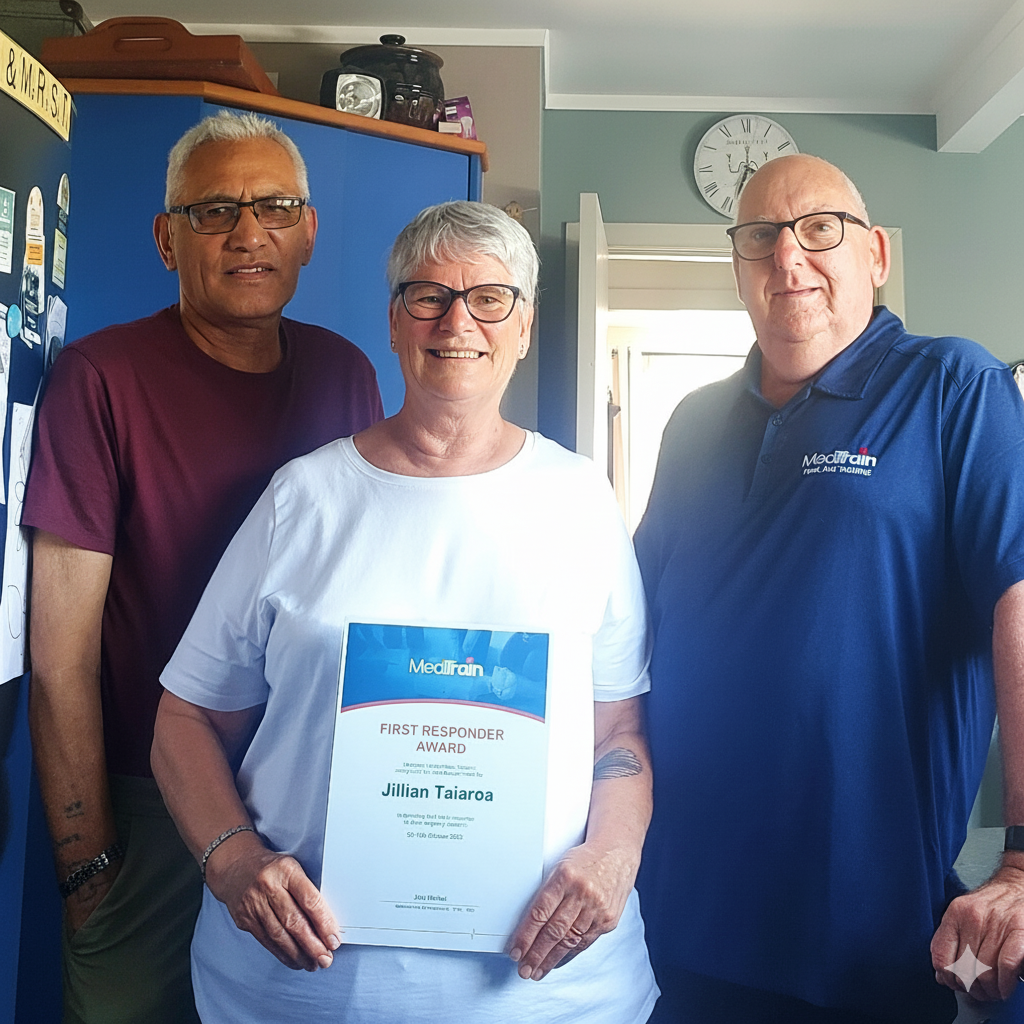
For her quick action and calm response in an emergency, Jillian received MediTrain's First Responders Award — recognition she's both humbled by and proud of.
But the real reward? Matt is home, recovering, alive.
"I'm pleased that you can maybe use my story to help others," Jillian says. "To help other people. Definitely."
Your First Aid Could Save a Life
Jillian's training with MediTrain gave her the confidence and skills to act when it mattered most. Whether you're a parent, a caregiver, or simply someone who wants to be prepared, first aid training is one of the most valuable skills you can have.
Ready to learn life-saving skills?
MediTrain offers NZQA-approved first aid and CPR courses across New Zealand, taught by experienced instructors (many of whom are paramedics and healthcare professionals). Our courses are:
- Practical and hands-on – not just reading from a manual
- Interactive and memorable – designed to help the knowledge stick
- Flexible – with online learning and in-person training
- Accessible – with courses available nationwide
From comprehensive workplace first aid to basic CPR, we'll help you build the confidence to act when every second counts.
Find your nearest AED: aedlocations.co.nz
MediTrain has been delivering quality first aid training across New Zealand for over 30 years. We believe every New Zealander should feel confident to help someone in an emergency.