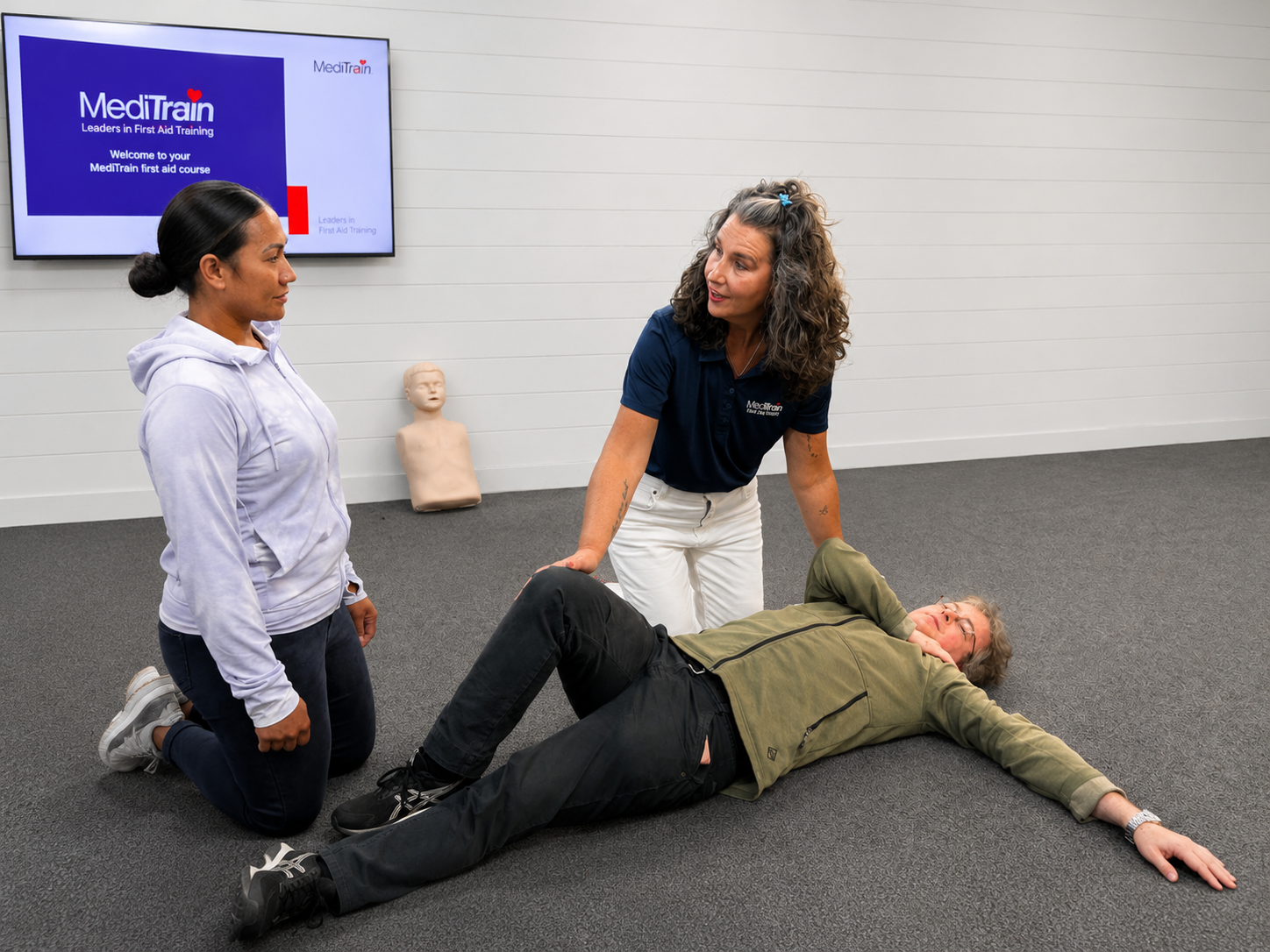
Partly. In New Zealand you cannot earn an NZQA-recognised first aid certificate entirely online, because the unit standards require you to demonstrate skills like CPR in person. What you can do is complete the theory online, in your own time, and then attend one day in class for the practical work and the assessment. That is called blended learning, and it is how MediTrain runs every public course.
This guide explains what online first aid courses advertised in New Zealand actually give you, how the blended format works, what the online part involves, and what happens on the day.
Why there is no fully online first aid certificate
The certificate your employer or licensing body asks for is built on NZQA unit standards. Unit standard 6402 is Provide basic life support, and it is assessed by doing it: CPR on a manikin, an AED, choking response, the recovery position. Unit standard 6401, Provide first aid, is assessed the same way. No amount of reading replaces an instructor watching you do it, which is why the national standard requires in-person assessment.
Some websites offer online-only first aid courses with a certificate at the end. These can be useful awareness training, but they do not carry the unit standards and most New Zealand employers, early childhood centres and registration bodies will not accept them as a first aid qualification. If you have been told to get a first aid certificate, check what the person asking actually needs before you pay for an online-only course. Our guide to the unit standards explains what to look for.
What blended learning means
Blended means the course is split in two. The theory is delivered online, before you come to class. The practical skills and the assessment happen in person, in one day. You get the same certificate and the same unit standards as a classroom-only course; the difference is where the theory happens.
For most people that is the better deal. The classroom day is shorter and almost entirely hands-on, because nobody is sitting through slides they could have read at home. For employers it means less time away from work. And for the person who dreads a full day of someone reading the manual aloud, it removes the reason to dread it.
What the online part is like
Once you book, you receive a login link to MediTrain's learning platform. It works on a phone, tablet or computer. The learning is broken into short sections with reading, videos, drag-and-drop activities and a quiz at the end of each one. If you miss a quiz question you only retry the ones you got wrong. There are no trick questions.
In the DRSABCD section, for example, you work through examples that help you spot danger, decide when to call for help and understand the steps to take in the first minutes of an emergency. By the time you walk into class you already know the sequence, so the day is spent practising it.
- You can pause and come back whenever it suits you.
- It is written in plain English, not medical jargon.
- It follows the current New Zealand Resuscitation Council guidelines.
- Your completion is recorded in the system. There is nothing to print or bring.
How long it takes depends on the course. The online part of a Comprehensive course is around four hours of self-study; a Refresher student needs no more than an hour and a half. The cost and duration guide has the times for each course.
MediTrain's General Manager, Adrian Brown, says the module was built with the same aim as the classes and the printed manual: making learning stick.
"We didn't want the online component to be just another hoop to jump through. It's about helping people actually learn and remember what to do in an emergency. We've put thought into making it simple, accessible, and something you can work through at your own pace, in your own time."
Adrian Brown, General Manager, MediTrain
What happens on the day
You attend one in-person session, usually a single day and shorter for a refresher. The instructor revisits the key theory, then it is practical: CPR on adult, child and infant manikins, using an AED, choking, bleeding, bandaging, and scenarios that put it together. The assessment is by doing, with props and photos rather than a written test. What to expect at a MediTrain class describes a typical day through one instructor's eyes.
Many of our instructors come from paramedic, nursing or healthcare backgrounds, which shows in how the scenarios are taught.
"What really stood out was his ability to relate the material to real-life situations, which helped me understand not just what to do in an emergency, but why it matters."
Ivana, Google review, Hamilton
"Information was freely shared, the practical components were easy and understandable, the instructional videos were great, effective and real."
Ema, Google review
Is a blended certificate the same as a classroom one?
Yes. The certificate carries the same unit standards and is valid for the same two years. Employers, early childhood licensing and registration bodies treat them identically, because they are the same qualification. The only thing that differs is how you learned the theory.
Can I do a refresher online?
The same way: a short online module, then about four and a half hours in class. Our refresher guide covers the two-year validity rule and the three-month grace period.
Quick answers
Can I get a first aid certificate completely online in NZ?
Not an NZQA-recognised one. NZQA unit standards require an in-person practical assessment, including CPR. If you don’t need unit standards or a CPR assessment, for example if you’re learning for personal knowledge, an online course may be enough.
What is a blended first aid course?
Theory online in your own time, then one day in class for practical skills and assessment.
How long does the online part take?
Around four hours for a Comprehensive course and up to an hour and a half for a Refresher.
Do I need to bring proof I finished the online learning?
No. Completion is recorded and your instructor can see it.
Book a blended first aid course
See all first aid courses and choose a date. Courses run most weeks in Auckland, Hamilton, Christchurch, Dunedin and New Plymouth, including Saturdays in many locations. If you are not sure which course you need, this guide will sort it out in two minutes.